
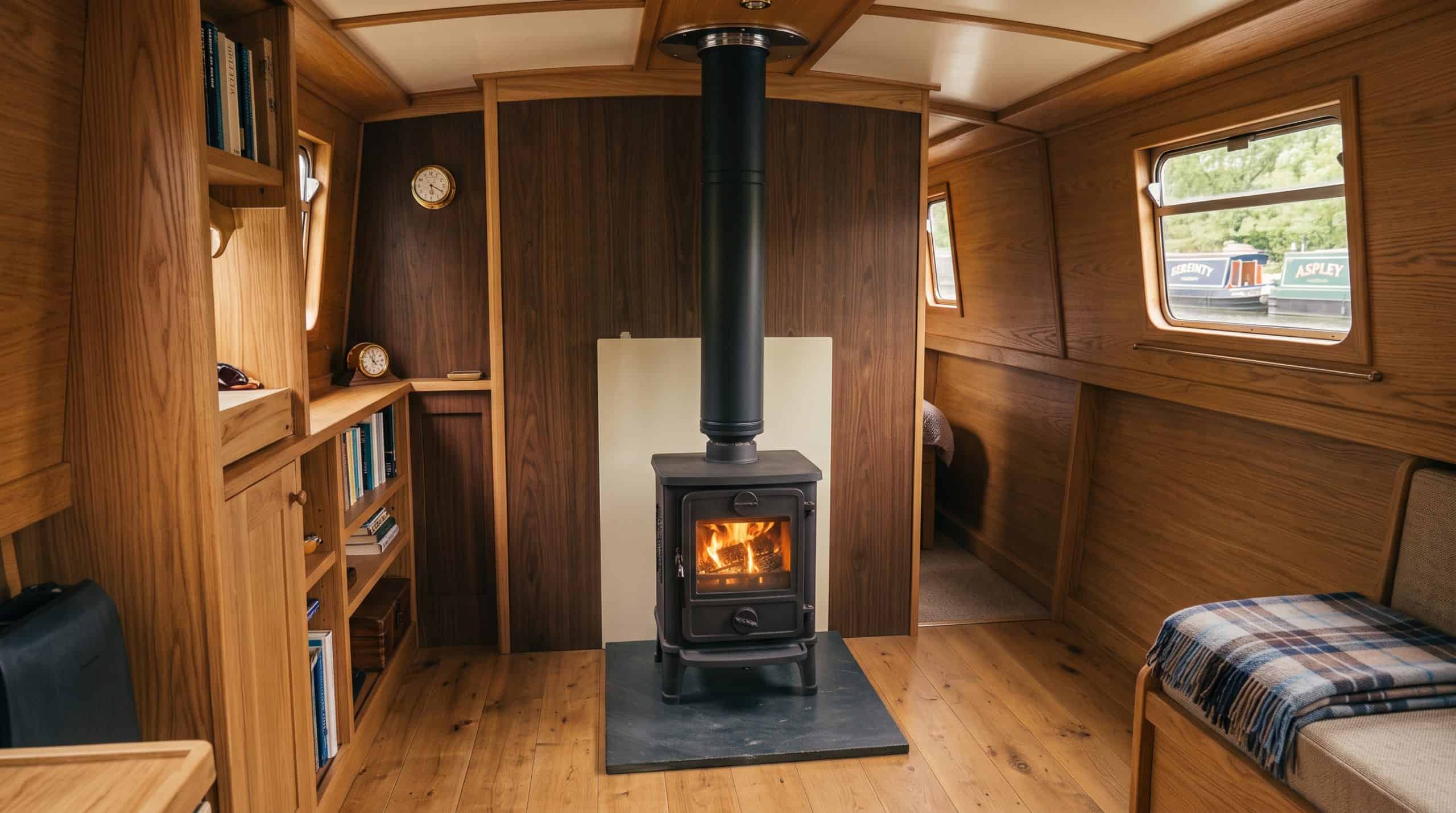
When I quote for a stove fitting through my professional solid fuel stove installation service, boat owners often ask why my specifications strictly require twin-wall insulated flues and calcium silicate thermal backing.
When researching boat stove installation standards online or browsing waterways forum threads, people frequently come across references to BS 8511:2010—the British Standard Code of Practice for stove installations on small craft. Boaters naturally note that this 2010 document technically permits single-skin flues under specific conditions or allows smaller clearance distances.
It’s completely understandable why this creates confusion. When an official standard seems to permit older methods, modern requirements can look overly complex by comparison.
However, as a specialist working on inland craft every day, my job isn’t to design to an outdated baseline—it’s to make sure your vessel is genuinely safe under real-world conditions. I insist on strict modern installation standards for a simple reason: relying on an outdated code of practice from 2010 is a risk neither your vessel nor my public liability insurance can take.
Why Hasn’t BS 8511 Been Updated?
BS 8511 was published in 2010 to provide boat builders and installers with a baseline framework for solid fuel heating. However, it hasn’t been revised since then. To understand why, you have to look at how the British Standards Institution (BSI) operates.
The BSI does not write or update technical standards in-house. They provide the administrative framework, while the actual technical writing is carried out by committees of unpaid industry volunteers, typically supported by trade bodies like HETAS or OFTEC.
Every five years, standards undergo a mandatory review. Rewriting a complex code requires significant time, administrative effort, and industry funding. If no trade group steps forward to chair and resource a complete rewrite, the BSI committee votes to “confirm” the existing standard.
BS 8511:2010 remains “confirmed” not because the industry views 2010 practices as cutting-edge, but to keep a baseline code active rather than leaving a total regulatory vacuum.
Guidelines vs. Engineering Reality: BSS, OFTEC, and Insurance
There is often confusion regarding where the Boat Safety Scheme (BSS) fits into installation rules. As an authorised BSS Examiner, I inspect vessels against the specific check items required by the scheme. The BSS publishes valuable solid fuel stove guidance and safety advice. However, a BSS examination is a baseline safety check—it is not a detailed engineering specification for designing a custom heating system.
When installing a stove, marine engineers do not carry out work “under” a BSS registration, nor do we enforce arbitrary rules outside the examiner checking procedure. Instead, professional engineering relies on OFTEC training, appliance manufacturer instructions, and current trade best practice.
While BS 8511:2010 is often cited on boating forums as the ultimate rulebook, it is fundamentally an outdated, non-compulsory advisory code. Relying on its 15-year-old minimums creates a dangerous false sense of security.
As a professional marine engineer, I am bound by modern safety requirements, not outdated minimums. Today’s high-efficiency Ecodesign stoves and current manufacturer instructions dictate strict thermal protections that go far beyond the old 2010 guidance. If I called my public liability insurer today and proposed fitting a single-skin flue or inadequate heat shielding simply because an old document didn’t explicitly ban it, they would refuse to cover the work.
What Modern Boat Stove Installation Standards Demand
To ensure a stove operates safely within the combustible confines of a boat cabin, modern OFTEC-trained installers follow proven industry safeguards:
- Insulated Twin-Wall Flues: Uninsulated single-skin flues cool smoke down rapidly, leading to heavier tar deposits, poor draw, rapid corrosion, and excessive heat transfer to cabin linings. Fully insulated twin-wall flues keep flue gases hot, improve draw, boost stove performance, and keep surrounding materials safe.
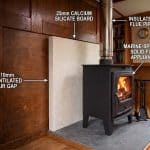
- Effective Thermal Backing: Fixing a single sheet of fireboard directly against a wooden bulkhead is inadequate because heat passes straight through it. Best practice requires a structured protection panel—such as a 10mm air gap behind a 25mm calcium silicate board—to prevent heat transfer into the vessel’s structure.
- Fixed Permanent Ventilation: Solid fuel stoves consume significant amounts of oxygen and require a continuous supply of fresh air to burn safely and prevent deadly carbon monoxide build-up. Rather than using rough estimates, every safe installation must verify airflow against the Boat Safety Scheme (BSS) fixed ventilation calculation formula. This ensures your vessel has sufficient, uncloseable free vent area based on the stove’s heat output, fuel type, and cabin layout.
When you hire a dedicated marine specialist, you are paying for an installation engineered to keep you safe under real-world conditions.
For a detailed look at the exact clearances, hearth dimensions, and structural safeguards required for your vessel, read my detailed guide on whether your boat stove is safe to use.
If you are planning a new stove fitting and want it installed to current OFTEC best practice that fully satisfies your insurer, get in touch today.