
When it comes to outfitting a galley or a compact mobile home, the temptation to “make do” with a standard domestic appliance is high. However, as a Gas Safe Registered engineer specialising in marine and leisure environments, I spend a significant portion of my time removing non-compliant units that pose a genuine risk to life.
The BSEN 10239:2025 Requirement: Why Marine Certification is Final
The core difference between a standard cooker and a marine cooking appliance is its legal certification for the marine environment. Under BSEN 10239:2025, it is a strict requirement that gas appliances are specifically engineered to withstand the unique mechanical stresses and corrosive atmospheres found on a vessel.
Crucially, this suitability must be explicitly stated within the Manufacturer’s Instructions (MIs). In my capacity as a Gas Safe Registered specialist, I often identify these non-compliant domestic units while carrying out LPG Safety Certificates. If the manufacturer has not clearly certified the appliance for marine use in their documentation, it is non-compliant for installation on a boat. Under gas safety regulations, I must verify that every appliance is “fit for purpose,” and a standard domestic unit simply lacks the specific engineering declarations required for life on the water.
Marine vs. LAV (Caravans): The Engineering Reality
In 2026, the era of “one size fits all” LPG appliances is over. As a Gas Safe Registered specialist with endorsements for both Boats and Leisure Accommodation Vehicles (LAVs), I frequently identify non-compliant units during LPG Safety Certificates.
The requirements differ based on the specific environmental stresses the appliance must survive:
- Marine (Inland Waterways): Governed by BSEN 10239:2025, these units must be engineered for the high-moisture, high-condensation, and salt-air environments typical of our canal network. They are also designed to handle the specific harmonic vibrations of a marine engine. If the Manufacturer’s Instructions (MI) do not explicitly state the unit is suitable for marine installation, it is legally non-compliant.
- LAVs (Caravans & Mobile Homes): While these units also face vibration during transit, they are generally installed in drier, more stable environments compared to a steel-hulled vessel. However, because these spaces are so tightly sealed for thermal insulation, the calculation of permanent fixed ventilation is the critical safety factor to prevent CO buildup.
- Domestic (Houses): These units are designed for static, high-volume, well-ventilated rooms. They completely lack the corrosion resistance and the specific ventilation-profile certification required for small-box leisure environments like a narrowboat.
Why the “Manufacturer’s Instruction” is Final
Regardless of the setting, the law is clear: the installer must verify that an appliance is “fit for purpose” according to the manufacturer. When I carry out an inspection, I am verifying that the unit itself is legally permitted to be in that specific environment.
By choosing a marine-certified cooking appliance and having it commissioned by an engineer with the correct boat or LAV endorsements, you ensure your installation is safe, legal, and compliant with both Gas Safe regulations and Boat Safety Scheme standards.
The Thetford Advantage
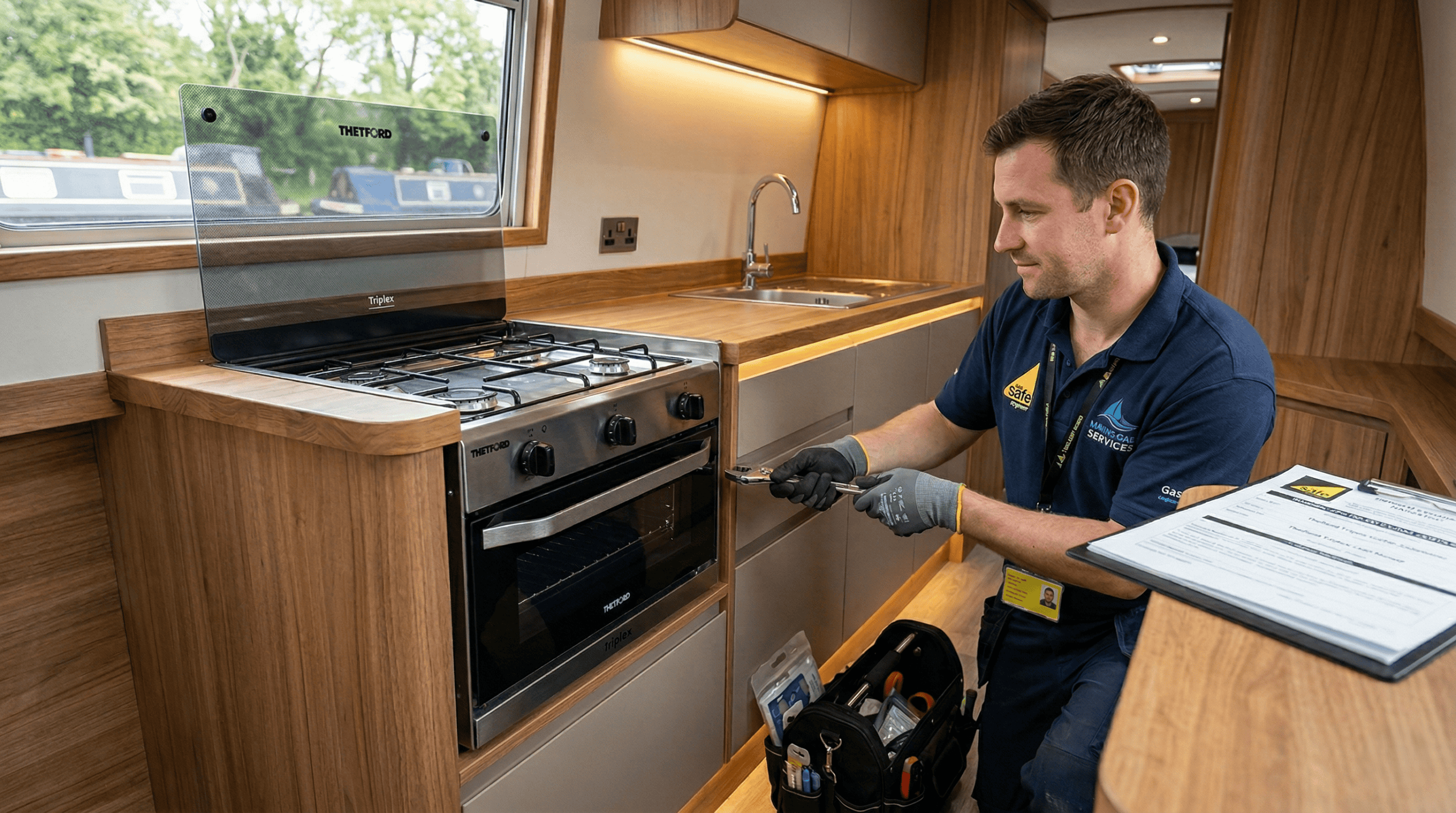
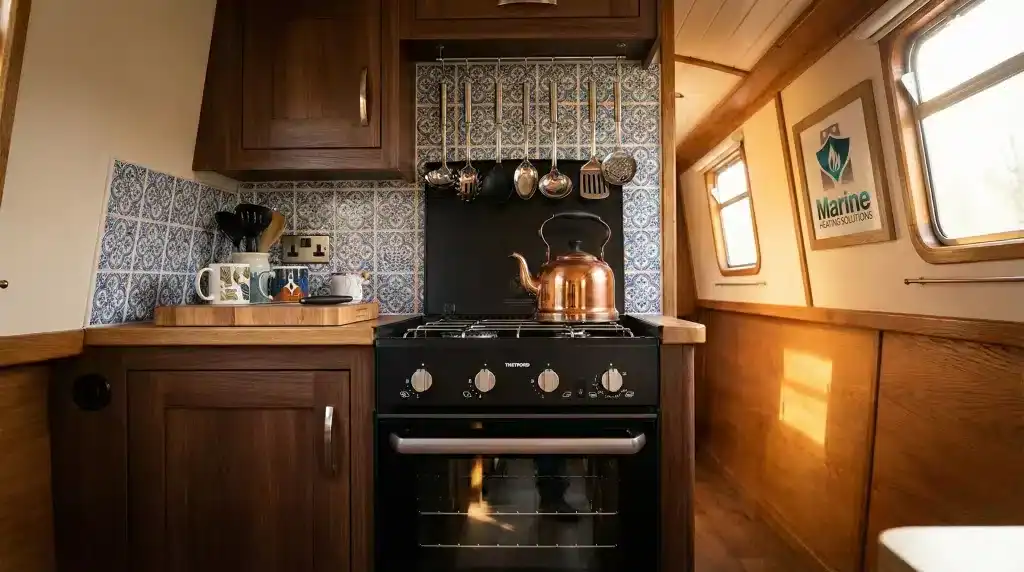
In my twenty years on the inland waterways, I’ve found Thetford to be the gold standard for reliability. Models like the Triplex or the K1520 are engineered specifically for the vibrations and corrosive salt-air of marine life. They are lightweight, efficient, and—most importantly—fully compliant with modern safety legislation.
The “Killer Deal” Strategy
Gas work is not a DIY project. In fact, if you live on your boat or rent it out, it is a legal requirement to have a Gas Safe engineer with “Marine” and “LPG” endorsements handle the installation.
Choosing a compliant appliance is only half the battle; the installation is what actually keeps you safe. At Marine Heating Solutions, I provide a comprehensive supply-and-fit service for Thetford and Dometic kits. By using a specialist Gas Safe engineer with 20 years of experience, you ensure your new cooker is correctly commissioned, fully BSS-compliant, and ready for life on the water from the moment the job is finished.