



The Path to Energy Independence
In 2026, the transition toward “silent motoring” and off-grid living has made boat solar panels the most requested upgrade for narrowboats and yachts alike. Whether you are looking to keep your leisure batteries topped up during a weekend trip or aiming for complete electrical independence while live-aboard, a well-designed solar array is the heart of your system.
Advancements in shingled cell technology and High-Efficiency PERC modules mean you can now generate more power from the limited roof space of a boat than ever before.
Thinking of an upgrade? View our Solar Installation Services.
1. Choosing Your Panels: Rigid vs. Flexible
The most common question for 2026 is whether to install traditional rigid panels or modern flexible ones. Each has a specific use case depending on your vessel’s design.
Rigid Monocrystalline Panels
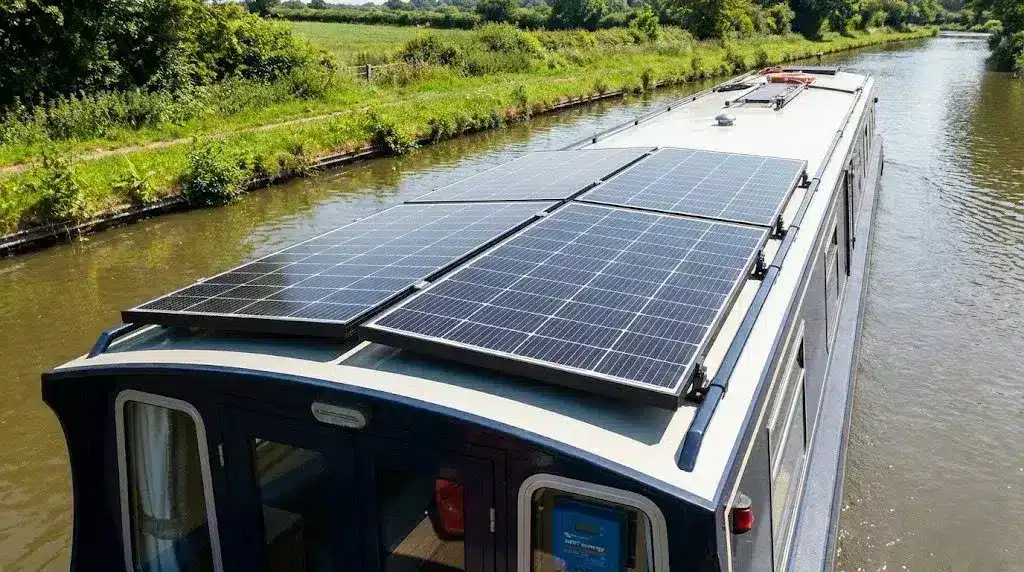
These remain the industry standard for narrowboats. They offer the highest longevity (often 20+ years) and the best heat dissipation due to the air gap created by the mounting brackets.
- Best for: Narrowboat roofs and fixed solar arches on yachts.
- Pro Tip: Look for “shingled” panels, which perform significantly better in partial shade—a common issue when moored under trees or near bridges.
Flexible & Semi-Flexible Panels
These panels can contour to the curved surfaces of a yacht’s coachroof or a camper-van’s roof. While they are lighter and more aerodynamic, they historically have had shorter lifespans due to heat build-up.
- 2026 Standard: Always opt for ETFE-coated flexible panels. They are more scratch-resistant and handle UV exposure much better than cheaper PET alternatives.

2. The Brain of the System: MPPT vs. PWM
A solar panel is only as good as the controller managing the energy flow to your batteries. For any marine installation in 2026, Victron Energy MPPT Controllers are the professional choice [cite: 2025-12-26].
- PWM (Pulse Width Modulation): Older, cheaper technology. It essentially acts as a switch. If your battery is half full, a PWM controller “chops” the panel’s voltage, losing up to 30% of your potential energy.
- MPPT (Maximum Power Point Tracking): This is the gold standard. It transforms the excess voltage from your panels into extra amperage for your batteries. In the UK’s often overcast conditions, an MPPT controller can harvest up to 30% more power than a PWM unit.
3. Sizing Your Solar Array
To determine how many boat solar panels you need, you must perform a “Daily Amp-Hour Audit”.
- Calculate Usage: A typical narrowboat might use 80Ah to 120Ah per day (fridge, lights, pumps, and laptop charging).
- The 2026 Rule of Thumb: In the UK, you generally want 1W of solar for every 1Ah of battery capacity. For a standard 440Ah battery bank, a 400W–500W solar array is the “sweet spot” for 3-season cruising.
- Winter Considerations: If you live aboard year-round, you may need to double this capacity or supplement with a Webasto Diesel Heater to reduce the electrical load of staying warm.
4. Safety & BSS Compliance
Incorrectly installed solar panels are a leading cause of electrical fires on boats. Your installation must meet Boat Safety Scheme (BSS) standards
- Fusing: You must have a fuse between the controller and the battery, and ideally a DC breaker between the panels and the controller for safe maintenance.
- Cable Sizing: 12V systems are sensitive to “voltage drop.” Always use 4mm² or 6mm² “solar cable” to ensure the energy makes it from the roof to your batteries without turning into heat.
- Roof Penetrations: Use high-quality, UV-stable cable glands (like those from Scanstrut) to prevent leaks into your cabin.

Conclusion
Investing in quality boat solar panels in 2026 is about more than just free power; it’s about the peace of mind that comes with a silent, reliable energy system. By choosing high-efficiency panels and a smart MPPT controller, you can enjoy the waterways without the constant hum of a running engine.

Comments are closed.