
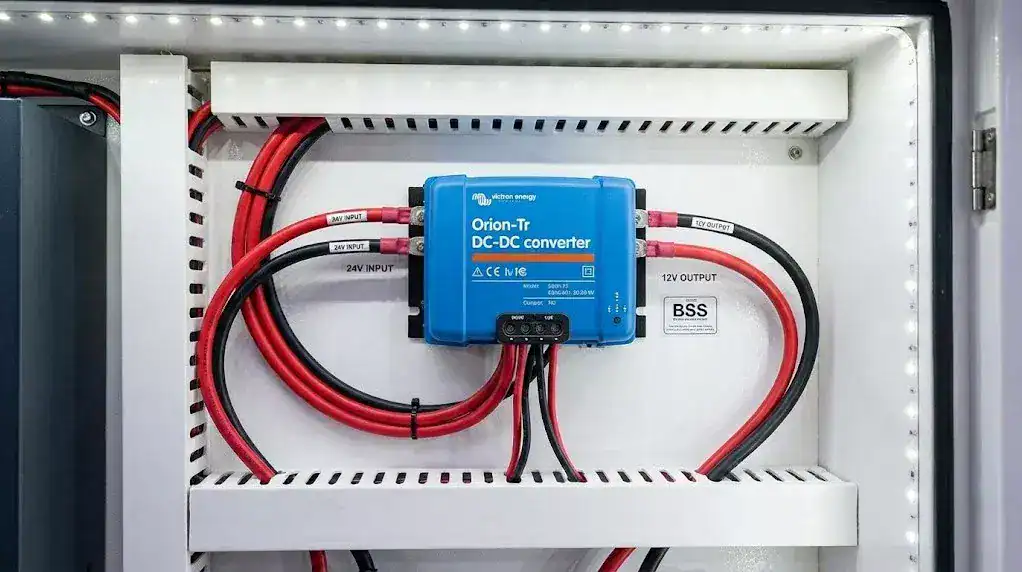



Bridging the Voltage Gap
As modern marine electrical systems move toward 24V for better efficiency and thinner cabling, the need for a reliable 24 to 12 V converter has never been higher. Most essential boat electronics—from VHF radios and plotters to standard 12V lighting—cannot handle the 24V-28V output of a heavy-duty battery bank.
For 2026, the industry has moved away from simple “voltage droppers” toward high-efficiency DC-DC Converters. These units ensure your sensitive 12V electronics receive a stable, “clean” voltage regardless of fluctuations in your primary battery bank during charging or heavy engine cranking.
1. Isolated vs. Non-Isolated: Which do you need?
When selecting a converter, the most important technical choice is whether you require an “Isolated” or “Non-Isolated” unit.
- Non-Isolated Converters: These have a common ground (negative). They are cost-effective and perfect for most narrowboat applications where the 12V and 24V systems share the same chassis ground.
- Isolated Converters: These provide a “galvanic barrier” between the input and output. These are essential for sensitive communication equipment (like SSB radios) or on metal hulls, where you must eliminate the risk of electrical noise or stray current electrolysis.
2. Efficiency and Heat Management
Older linear converters wasted excess energy as heat. In 2026, we exclusively recommend “Switching Regulators” from brands like Victron Energy [cite: 2025-12-26, 2025-12-28]. These units operate at over 90% efficiency, which is vital for preserving your leisure battery capacity while off-grid.
Pro-Tip: Because even efficient converters generate some heat, they must be mounted vertically on a non-combustible surface with at least 10cm of clearance to allow for natural convection cooling.
3. Installation & BSS Safety
A 24 to 12 V converter is a power source and must be treated as such during a Boat Safety Scheme (BSS) inspection:
- Dual Fusing: You must fuse the 24V input (to protect the cable from the battery) and the 12V output (to protect your devices).
- Cable Sizing: 12V systems are highly sensitive to “voltage drop.” Ensure your output cables are sized for the total amperage of all 12V devices running simultaneously.
- Secure Terminals: Use high-quality crimped ferrules on all wire ends to ensure a vibration-proof connection.
Conclusion: Powering Your Onboard Tech
A quality 24 to 12 V converter is the bridge that allows you to enjoy the efficiency of a 24V power bank without sacrificing your 12V accessories. By choosing a high-efficiency unit and following BSS installation standards, you ensure a safe and reliable electrical backbone for your vessel.